
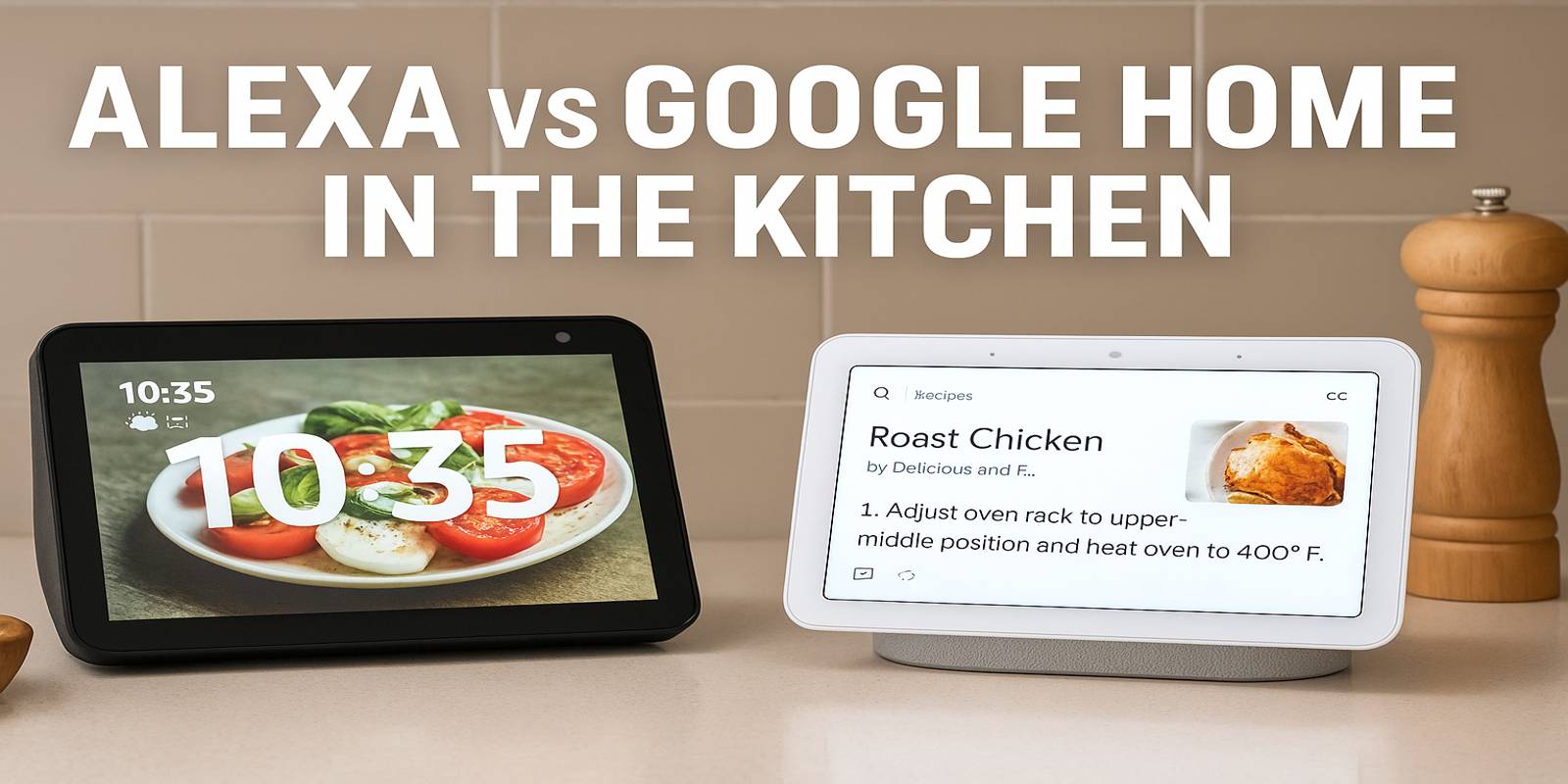
In 2026, smart assistants have officially moved from our living rooms to our kitchens. Whether you’re juggling pots, timers, or recipes, voice-activated devices like Amazon Alexa and Google Home make multitasking easier than ever. But when it comes to cooking convenience, hands-free control, and compatibility with modern appliances, which one truly deserves a spot on your counter? Let’s find out.
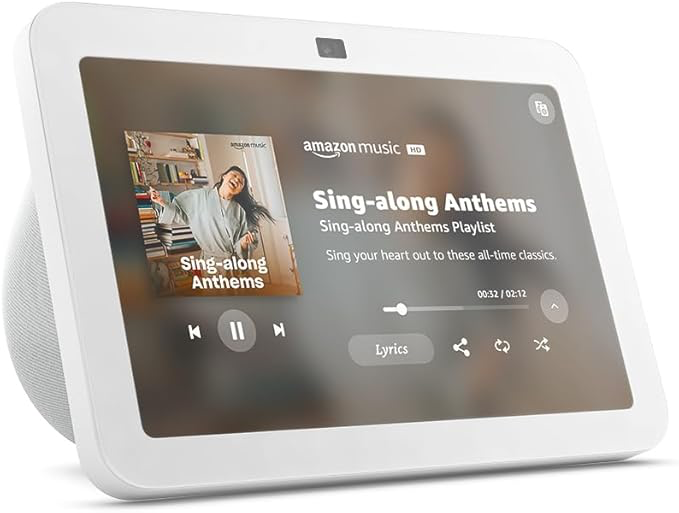
— AMAZON ALEXA —
— GOOGLE HOME —
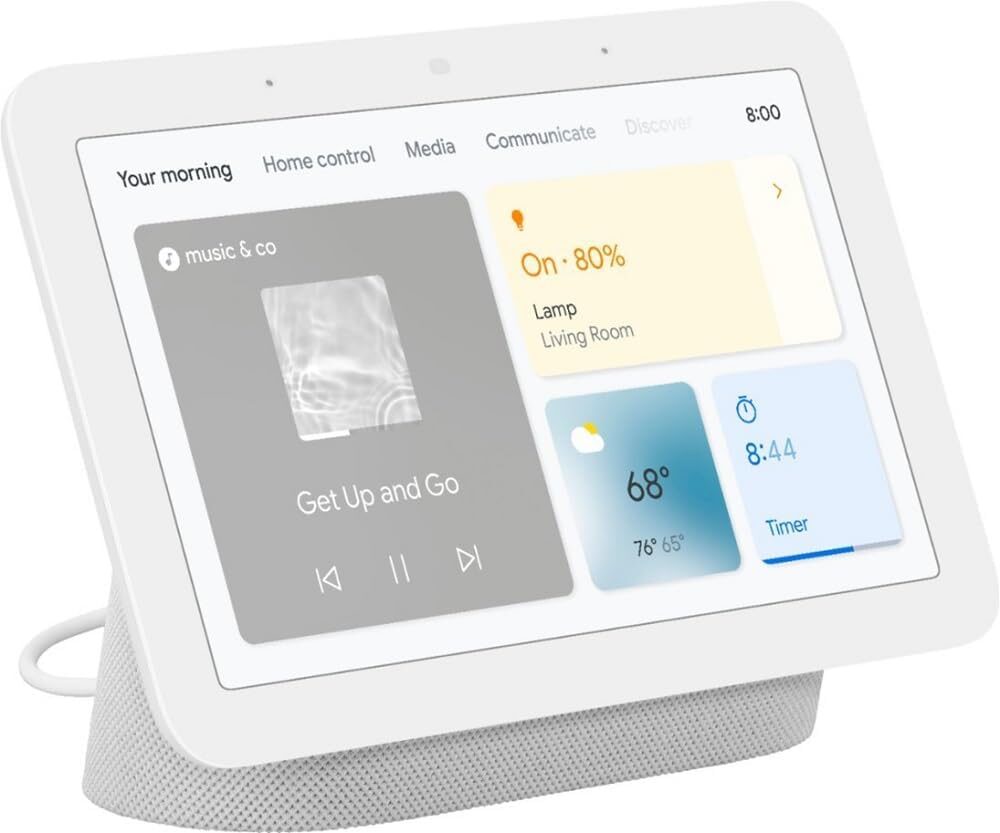
Table of Contents
1. Smart Kitchen Revolution: Why Voice Assistants Belong in the Kitchen
The kitchen has become the hub of connected living. With an increasing number of smart ovens, air fryers, and coffee machines, voice assistants now act as the digital sous-chef of the modern home. Both Alexa and Google Home can handle timers, recipe queries, grocery lists, and even appliance control. The difference lies in how smoothly they integrate with your ecosystem and how well they interpret your commands amid sizzling pans and boiling water.
2. Design and Setup: How Alexa and Google Home Fit Your Counter Space
Alexa’s Strengths in the Kitchen
Amazon’s Echo lineup — especially the Echo Show 8 and Echo Show 10 — is designed with kitchens in mind. Here are the outstanding features of Alexa Smart Home application:
- The angled screens
- Adjustable stands
- Vibrant displays make following video recipes effortless
- Setup takes minutes using the Alexa app
- Wi-Fi connection is stable
- The microphones are powerful enough to hear your commands even with the blender running
Google Home’s Edge
Compared to Alexa, Google Home has advantages in following perspectives:
- Google’s smart displays, such as the Nest Hub 2nd Gen, offer a minimalist footprint and a bright, responsive screen.
- The real advantage is the integration with YouTube, letting you stream recipe tutorials directly by voice.
- Setup through the Google Home app is intuitive
- The display automatically adjusts brightness based on ambient light
- For small kitchens or apartment counters, Google’s slim design feels less intrusive than Alexa’s boxier profile

3. Voice Accuracy and Responsiveness: Who Hears You Better Over Kitchen Noise?
Voice recognition is crucial when your hands are messy. Alexa responds faster to short, direct commands — for instance, “Alexa, set a 10-minute timer” or “Alexa, add milk to my list.” It’s optimized for quick, task-oriented actions. Google Home, however, excels at understanding context. You can say, “Hey Google, how much butter do I need if I double the recipe?” and it will give an accurate, contextual answer. In noisy environments, both systems handle background sounds well, but Amazon’s far-field microphones give it a slight edge in busy kitchens.
4. Recipe Assistance and Cooking Guidance
When it comes to actual cooking help, Alexa relies on partnerships with recipe apps like Food Network Kitchen and Allrecipes. You can ask, “Alexa, show me a pasta recipe,” and swipe through step-by-step instructions or watch cooking videos on the Echo Show. Google Home integrates directly with Google Search and YouTube, giving it access to a massive range of recipes — from text to video. If you prefer visual instructions, Google wins here. If you like structured, guided recipes and built-in shopping lists, Alexa feels more organized.
5. Smart Appliance Integration: Which Ecosystem Works with More Devices?
Amazon currently supports more smart-kitchen brands, including Instant Brands (Instant Pot, Vortex Air Fryer), Samsung SmartThings, and Whirlpool. You can tell Alexa to preheat your oven or start your air fryer before dinner. Google Home has caught up rapidly, integrating with GE Appliances, LG ThinQ, and select Whirlpool models, but Alexa’s broader third-party network still makes it the better choice for fully connected kitchens. If you already use Alexa-enabled plugs, bulbs, or security devices, staying within the Amazon ecosystem keeps everything unified.
6. Timers, Measurements, and Daily Cooking Tasks
Both assistants handle multiple timers, but Alexa makes labeling easier — “Alexa, set pasta timer for 8 minutes” and “set sauce timer for 10.” It will even announce which timer is finishing first. Google Home, meanwhile, shines in conversions and calculations. It can answer “How many grams are in one-third cup of butter?” instantly. For baking or precision cooking, Google’s knowledge graph gives it a clear advantage in measurement accuracy.
7. Music, Podcasts, and Entertainment While You Cook
Cooking doesn’t have to be silent. Alexa connects seamlessly to Amazon Music, Spotify, Apple Music, and Audible, while Google Home integrates tightly with YouTube Music, Spotify, and Google Podcasts. Audio quality on the Echo Show 10 is richer and louder, making it ideal for open kitchens. The Nest Hub offers slightly clearer treble for spoken content. Both can stream cooking videos, news, or your favorite playlist hands-free — it’s really a matter of platform loyalty.
8. Privacy and Data Concerns in a Smart Kitchen
Privacy remains an ongoing concern. Both companies allow you to delete voice recordings or mute microphones. Amazon provides clearer voice-recording deletion commands (“Alexa, delete what I just said”), while Google makes privacy settings easier to manage from the app dashboard. Neither device listens continuously beyond the wake word, but users should still position them away from sinks or steamy spots to prevent accidental activations. Ultimately, both brands are transparent about data usage, but Google’s data policies integrate more deeply with your wider account activity.
9. Pricing, Ecosystem, and Long-Term Value
Price-wise, both ecosystems are highly competitive. The Echo Show 8 typically retails around $90–$110, while the Nest Hub 2nd Gen sells for about $80–$100. If you already own Alexa-enabled plugs, smart bulbs, or Fire TV devices, Alexa integrates more smoothly and offers better bundle deals on Amazon. If you’re deep into Android, YouTube, or Chromecast, Google Home provides more unified control. Both brands receive regular updates, ensuring longevity and new skills over time.
10. Final Verdict: Alexa or Google Home — Who Rules the Kitchen?
So, who wins the smart-kitchen showdown? If your priority is appliance control, multitasking, and ecosystem depth, Alexa is the smarter investment — especially if your kitchen already features Alexa-compatible devices. If you want contextual answers, YouTube recipes, and better Google-search integration, Google Home is the more natural fit. For visual learners, the Echo Show and Nest Hub both deliver excellent step-by-step cooking help, so your choice may simply depend on which ecosystem you already live in.

Hi, I’m Maria from Los Angles. Born and raised in a family of avid home cooks, developed a love for food at a young age. I remember spending weekends in the kitchen with her parents, learning how to make family favorites like lasagna and chocolate chip cookies. After graduating from college, started working as a marketing manager for a tech company, but I found myself spending all of her free time in the kitchen. Then I decided to share my experiences on FindForKitchen blog.